Workstation in Airport Cargo Handling:
In modern air cargo operations one of the most vital components is workstation. It integrated mechanical and hydraulic platform designed specifically for handling Unit Load Devices (ULD). Whether in export or import terminals, workstations play a central role in building up, breaking down, weighing, and transferring cargo. This article explains the design, operation, and importance of workstations in airport cargo handling systems—based on real system architecture such as ECT (Export Cargo Terminal) and ICT (Import Cargo Terminal) installations.
What is a Workstation in Cargo Handling?
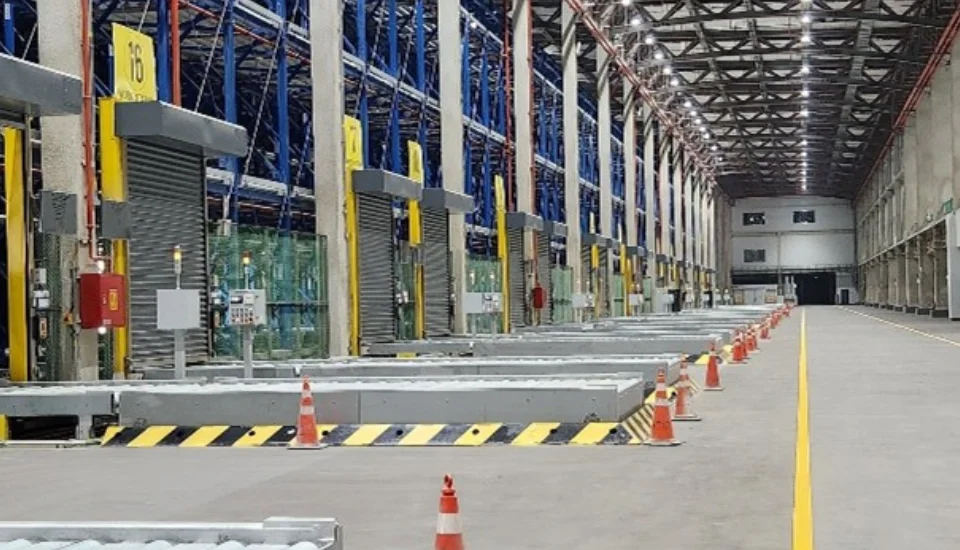
A workstation is a specialized platform where cargo is assembled onto ULDs (build-up) or removed from ULD (break-down). It includes a hydraulic scissor lift integrated with a roller deck that enables multi-directional movement of ULD such as pallets or containers. Installed inside a concrete pit, the workstation can move vertically to align with different equipment heights, conveyors, Tilting Dollies, ETV/ASRS systems.
The workstation is not just a table—it is a mechanical, hydraulic, and electrical system designed for precision, safety, and heavy-duty cargo handling.
Mechanical & Hydraulic Design of the Workstation
- Hydraulic Scissor Lift Structure
At the core of the workstation is the hydraulic scissor lift, built with:
- Steel support frame mounted on the concrete pit
- Top platform with roller deck for ULD movement
- Heavy-duty scissor arms responsible for vertical motion
- Two hydraulic cylinders generating lifting force
- Safety props for maintenance locking
- Steel side skirts for operator protection
- Low-profile steel barriers to prevent forklift or dolly impact
The workstation can adjust from above floor level to below floor level, allowing seamless connection between different cargo systems.

- Hydraulic Power Pack (HPP)
The workstation uses a dedicated Hydraulic Power Pack, which contains:
- Hydraulic Pump
- Electric Motor
- Oil Tank / Reservoir
- Control Valves
- Filters
- Pressure Gauge
- Breather
The HPP supplies pressurized oil through flexible hoses and rupture valves, ensuring safe and reliable operation.
- Hydraulic Components and Their Roles
Hydraulic Cylinder
Converts hydraulic pressure into linear motion to raise or lower the scissor lift.
Hydraulic Pump
Creates pressure by drawing oil from the tank and supplying it to the cylinders.
Flow Control Valve
Regulates the speed of lift movement by controlling oil flow rate.
Solenoid Valve
Electrically opens or closes oil passage to control UP/DOWN movement.
Filters (Return & Suction)
Keep the oil clean by removing metal particles, dust, and dirt.
Pressure Relief Valve
Protects the system from over-pressure by diverting excess oil back to the tank.
Air Breather
Allows the tank to breathe while filtering incoming air
Important of Workstation in ULD Systems
Workstations are indispensable in cargo handling. Here are the major reasons:
- Ensures Accurate ULD Build-Up and Break-Down
The workstation provides a dedicated platform for:
- Assembling export cargo onto ULDs
- Removing cargo from import ULDs
Without a workstation, these processes become slow, manual, and unsafe.
- Provides Adjustable Working Height
Different equipment—trucks, dollies, conveyors—are at different heights.
The hydraulic lift aligns the ULD with:
- Build-up staff
- Loading docks
- Transfer conveyors
- ETV or ASRS systems
This ensures smooth cargo flow.
- Enhances Safety
Workstations include:
- Safety props
- Emergency stop
- Over-pressure protection
- Electrical and hydraulic interlocks
- Steel barriers
This minimizes accidents during heavy cargo handling.


Lorem ipsum dolor sit amet, consectetur adipiscing elit. Ut elit tellus, luctus nec ullamcorper mattis, pulvinar dapibus leo.4. Improves Efficiency and Throughput
With integrated roller decks, automatic modes, and weight systems, workstations:
- Speed up cargo processing
- Reduce manual handling
- Allow faster aircraft turnaround
This is crucial for busy airports.
5. Ensures Accurate Weight for Load Planning
The built-in scale and monitor ensure:
- Correct cargo weight
- Compliance with airline limits
- Safe aircraft center-of-gravity calculations
Over-weight or unbalanced cargo can cause severe flight risks.
6. Supports Modern Automation
Workstations integrate with:
- ASRS (Automated Storage & Retrieval Systems)
- ETV (Elevating Transfer Vehicles)
- Conveyor lines
- Cargo management software
They act as the interface between human operation and automation.
7. Reduces Labor Effort and Injury Risks
Ergonomic design prevents:
- Back injuries
- Muscle fatigue
- Heavy lifting accidents
Hydraulic height adjustment allows operators to work comfortably.
Conclusion
The workstation is one of the most essential elements in an airport cargo handling system. Its combination of hydraulic lifting, precise weighing, automated control, and safety systems allows efficient handling of ULDs in both export and import terminals. By improving speed, accuracy, and safety, the workstation directly contributes to smoother cargo movement, reduced aircraft turnaround time, and compliance with global aviation standards.